07 September 2026


Foreign investors registered a total of US$34.65 billion in investments in Vietnam during the first half of 2026, representing a 61% year-on-year (YoY) increase. Manufacturing continued to attract the majority of capital, drawing approximately US$18.47 billion, equivalent to more than half of total registered FDI and marking a significant increase compared with H1/2025. Of this figure, US$10.71 billion was attributable to newly registered manufacturing FDI projects.
While the total number of new manufacturing projects declined to 468 projects, compared with 759 projects in H1/2025, the sharp increase in capital demonstrates that investor activity was increasingly concentrated in a smaller number of large-scale projects. This trend reflects Vietnam’s continued success in attracting higher-value manufacturing investments, particularly in technology-intensive sectors. It also suggests a shift from broad-based small project registrations toward fewer, larger and more capital-intensive manufacturing commitments.
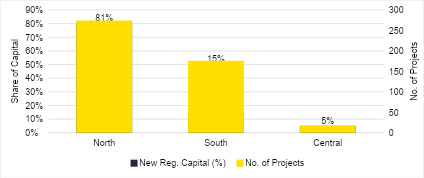
The Northern Region strengthened its position as Vietnam’s dominant manufacturing destination during H1/2026, attracting approximately US$8.63 billion, equivalent to 80.5% of all newly registered manufacturing FDI capital. The region also accounted for 274 new manufacturing projects, highlighting both scale and depth of investor activity.
The South recorded 176 projects and approximately US$1.57 billion in newly registered manufacturing capital, while the Central Region attracted 18 projects and approximately US$517 million. Although both regions continued to attract investment, the scale of several major projects announced in the North resulted in a pronounced regional imbalance during the first half of the year.
Figure 1: Newly Registered Manufacturing FDI by Region, H1/2026
Source: Savills Vietnam, 2026
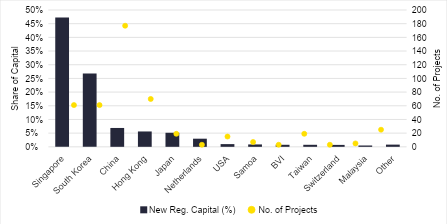
Singapore emerged as the largest source of newly registered manufacturing FDI in H1/2026, contributing over US$5.06 billion, equivalent to approximately 47% of total manufacturing capital. South Korea followed with approximately US$2.87 billion or 27% of total capital. Combined, these two markets accounted for approximately 74% of all newly registered manufacturing FDI capital during the period.
China remained the most active investor by project count, with 177 new projects, significantly ahead of Hong Kong (70 projects), Singapore (61 projects) and South Korea (61 projects). This highlights an increasingly familiar trend whereby Chinese manufacturers lead in project volume, while Singaporean and Korean capital is concentrated in a smaller number of large-scale investments.
Other notable manufacturing investors included Hong Kong, Japan, the Netherlands, the United States and Taiwan, further reinforcing Vietnam’s diversified manufacturing investor base.
Note: While Singapore accounted for the largest share of newly registered manufacturing FDI capital in H1/2026, this was significantly influenced by Samsung Semiconductor Asia Holdings’ investment of more than US$4 billion. Although recorded in MPI data as investment originating from Singapore, the project is ultimately associated with Samsung, a South Korean multinational. As such, readers should consider this transaction when interpreting country-level FDI rankings, as South Korean-linked investors continued to play a major role in Vietnam’s manufacturing investment landscape.
Figure 2: Newly Registered Manufacturing FDI by Country, H1/2026
Source: Savills Vietnam, 2026
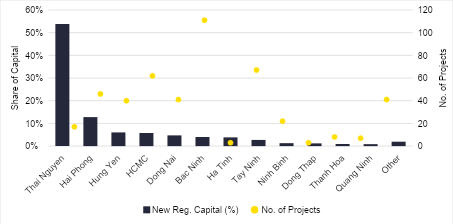
At the provincial level, Thai Nguyen was the clear leader during H1/2026, attracting approximately US$5.77 billion of newly registered manufacturing FDI across 17 projects. The province alone accounted for more than half of Vietnam’s total newly registered manufacturing capital during the period.
Hai Phong ranked second with approximately US$1.37 billion, followed by Hung Yen (US$646 million), Ho Chi Minh City (US$618 million), and Dong Nai (US$506 million). In terms of project activity, Bac Ninh recorded the highest number of projects nationwide with 111 projects, demonstrating the continued attractiveness of the Northern manufacturing ecosystem.
The South remained active by project count, particularly in HCMC, Dong Nai and Tay Ninh. However, the capital story in H1/2026 was clearly led by the North which continues to benefit from ongoing semiconductor, electronics and precision manufacturing investment.
Figure 3: Newly Registered Manufacturing FDI by Province, H1/2026
Source: Savills Vietnam, 2026
“Fewer projects, much larger investments, driven by a semiconductor and electronics boom centred in Northern Vietnam”
John Campbell, Head of Industrial Services, Savills Vietnam
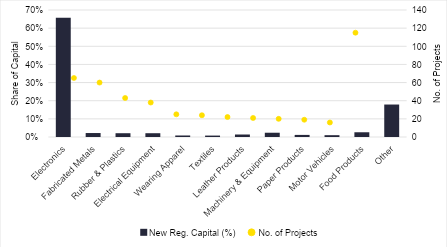
Vietnam’s manufacturing sector in H1/2026 was overwhelmingly driven by high-tech and electronics-related investments. Computers, Electronics & Optical Products attracted over US$7.03 billion, representing approximately 66% of total newly registered manufacturing capital. Despite accounting for only 65 projects, the sector generated by far the largest share of investment value.
Beyond electronics, investment activity remained diversified. Other notable sectors included fabricated metal products, machinery & equipment, electrical equipment, rubber & plastics products, food products, paper products and automotive-related manufacturing. This broad distribution of investment across sectors reinforces Vietnam’s continued development as a diversified manufacturing platform rather than a single-industry destination.
Several of the year’s largest investments were directly linked to semiconductor packaging, electronic components, precision engineering and advanced manufacturing supply chains, reinforcing Vietnam’s position within regional technology manufacturing networks.
Figure 4: Newly Registered Manufacturing FDI by Industry, H1/2026
Source: Savills Vietnam, 2026
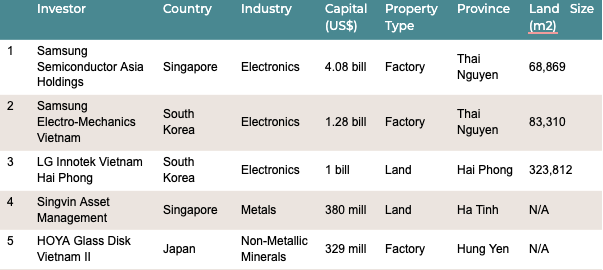
One of the defining features of H1/2026 was the concentration of capital into a small number of exceptionally large projects, especially from Samsung’s semiconductor and electro-mechanics businesses.
Combined, the top three projects accounted for approximately US$6.36 billion, representing nearly 60% of all newly registered manufacturing FDI capital recorded during H1/2026. This explains why total manufacturing investment surged despite a reduction in the overall number of new projects. The data points to a clear shift toward larger, higher-value investments, particularly within semiconductor, electronics and advanced manufacturing industries.
Table 1: Top 5 New Manufacturing FDI Investments, 6M/2025
Electronics manufacturing FDI was the standout performer in H1/2026. Although the number of new electronics projects declined from 99 in H1/2025 to 65 in H1/2026, total newly registered electronics manufacturing capital increased sharply from approximately US$984.5 million to US$7.03 billion. This reflects a clear shift toward fewer but significantly larger electronics, semiconductor and advanced manufacturing investments.
Table 2: New Manufacturing FDI Performance, 6M/2026 vs 6M/2025

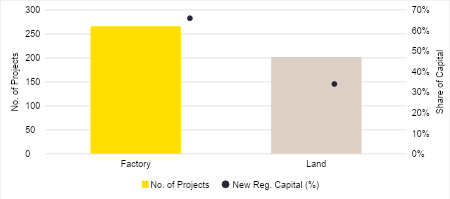
Factory deals continued to lead new manufacturing FDI activity in H1/2026, both in terms of project count and capital value. Of the 468 newly registered manufacturing FDI projects, 266 projects, or 56.84%, were classified as Factory deals. By capital investment, Factory deals accounted for approximately US$7.09 billion, representing 66.24% of total newly registered manufacturing FDI.
Land deals remained highly relevant, with 202 projects, or 43.16% of all newly registered manufacturing FDI projects. By investment value, Land deals attracted approximately US$3.62 billion, equivalent to 33.76% of newly registered manufacturing FDI capital. This shows that although factory transactions led the market, land-based projects still accounted for more than one-third of total new manufacturing FDI capital in H1/2026.
The continued strength of Factory deals reflects investors’ preference for speed, flexibility, and faster operational setup. Ready-built and operational facilities remain particularly attractive for manufacturers that need to shorten the time between licensing, fit-out, and production. This is especially relevant in electronics, components, light manufacturing, and supply-chain-related sectors where speed to operation can be a major competitive advantage.
By capital value, Factory deals also moved further ahead of Land deals in H1/2026. This is notable because land deals have historically accounted for a large share of investment value due to their long-term development nature and larger capital commitments. In H1/2026, however, Factory deals captured nearly two-thirds of newly registered manufacturing FDI capital, suggesting that factory-based investment is no longer only a volume story, but also a capital story.
Figure 5: National Newly Registered Manufacturing FDI by Property Type, H1/2026
Source: Savills Vietnam, 2026
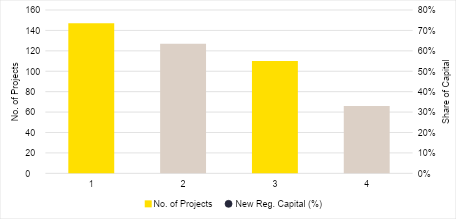
At the regional level, the Northern region showed the strongest factory-led pattern. Factory deals accounted for 147 projects, or 54% of the Northern region’s new manufacturing FDI projects, but represented a much larger 73% of capital, equivalent to approximately US$6.30 billion. Land deals accounted for 127 projects, or 46%, and approximately US$2.33 billion, equal to 27% of capital.
In the Southern region, Factory deals also led by project count, with 110 projects, or 63% of the Southern region’s total, compared with 66 Land projects, or 38%. However, by capital investment, the region was evenly balanced, with both Factory and Land deals each accounting for approximately 50% of newly registered manufacturing FDI capital. This suggests that while more investors in the South are choosing factory-based solutions, land remains equally important in terms of investment value.
Figure 6: North vs South Newly Registered Manufacturing FDI by Property Type, H1/2026
Source: Savills Vietnam, 2026
Overall, H1/2026 confirms that Vietnam’s newly registered manufacturing FDI market is becoming increasingly factory-led. Factory deals represented the majority of new project activity nationally and captured almost two-thirds of total newly registered manufacturing FDI capital. However, land remains essential, particularly for larger greenfield and expansion projects. For industrial real estate developers, the implication is clear: demand is no longer only about industrial land supply but also about high-quality, ready-built factory platforms that allow manufacturers to move quickly from licensing to production.
Manufacturing Definition: For the purposes of this analysis, manufacturing FDI comprises the following industry categories captured within the underlying MPI data: Beverages; Chemicals & Chemical Products; Computers, Electronics & Optical Products; Electrical Equipment; Fabricated Metal Products; Food Products; Furniture; Leather & Leather Products; Repair & Installation of Machinery & Equipment; Machinery & Equipment; Metals; Motor Vehicles; Other Non-Metallic Mineral Products; Other Transport Equipment; Paper & Paper Products; Pharmaceuticals, Medicinal Chemical & Botanical Products; Printing & Reproduction of Recorded Media; Refined Petroleum Products; Rubber & Plastics Products; Textiles; Tobacco Products; Wearing Apparel; Wood & Wood Products; and Other Manufacturing.